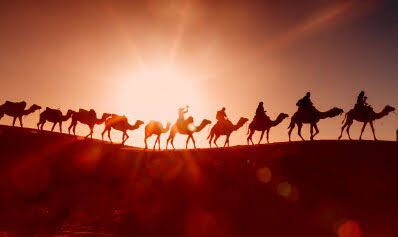
Long ago, there lived an old man with his three sons in a deserted village, located in the vicinity of a desert. He had 17 camels, and they were the main source of his income. He used to rent out camels as a means of shipping in the desert. One day, he passed away. He had left a will, leaving his assets for his three sons.
After the funeral and the other obligations were over, the three sons read the will. While their father had divided all the property he had into three equal parts, he had divided the 17 camels in a different way. They were not shared equally among the three as ‘17’ is an odd number and a prime number, which cannot be divided.
The old man had stated that the eldest son will own half of the 17 camels, the middle one will get one third of the 17 camels, and the youngest one will get his share of camels as one ninth!
All of them were stunned to read the will and questioned each other how to divide the 17 camels as mentioned in the will. It is not possible to divide 17 camels and give half of the 17 camels to the eldest one. It is not possible also to divide the camels for the other two sons.
They spent several days thinking of ways to divide the camels as mentioned in the will, but none could find the answer.
They finally took the issue to the wise man in their village. The wise man heard the problem and instantly found a solution. He asked them to bring all the 17 camels to him.
The sons brought the camels to the wise man’s place. The wise man added a camel owned by him and made the total number of camels 18.
Now, he asked the first son to read the will. As per the will, the eldest son got half the camels, which now counted to 18 / 2 = 9 camels! The eldest one got 9 camels as his share.
The remaining camels were 9.
The wise man asked the second son to read the will. He was assigned 1 / 3 of the total camels.
It came to 18 / 3 = 6 camels. The second son got 6 camels as his share.
Total number of camels shared by the elder sons – 9 + 6 = 15 camels.
The third son read out his share of camels: 1 / 9th of the total number of camels – 18 / 9 = 2 camels.
The youngest one got 2 camels as his share.
Totally there were 9 + 6 + 2 camels shared by the brothers, which counted to 17 camels.
Now, the one camel added by the wise man was taken back.
The wise man solved this problem smartly with his intelligence.
Intelligence is nothing but finding a common ground to solve an issue. In short, every problem has a solution.
KIDS and HEALTH
Your Skin
Quick! What’s the body’s biggest organ?
You might be surprised to find out it’s the skin, which you might not think of as an organ. No matter how you think of it, your skin is very important. It covers and protects everything inside your body. Without skin, people’s muscles, bones, and organs would be hanging out all over the place. Skin holds everything together. It also: protects our bodies, helps keep our bodies at just the right temperature and allows us to have the sense of touch
Don’t miss your epidermis
The skin is made up of three layers, each with its own important parts. The layer on the outside is called the epidermis (say: eh-pih-DUR-mis). The epidermis is the part of your skin you can see.
Look down at your hands for a minute. Even though you can’t see anything happening, your epidermis is hard at work. At the bottom of the epidermis, new skin cells are forming.
When the cells are ready, they start moving toward the top of your epidermis. This trip takes about 2 weeks to a month. As newer cells continue to move up, older cells near the top die and rise to the surface of your skin. What you see on your hands (and everywhere else on your body) are really dead skin cells.
Bye-bye skin cells
These old cells are tough and strong, just right for covering your body and protecting it. But they only stick around for a little while. Soon, they’ll flake off. Though you can’t see it happening, every minute of the day we lose about 30,000 to 40,000 dead skin cells off the surface of our skin.
So just in the time it took you to read this far, you’ve probably lost about 40,000 cells. That’s almost 9 pounds (4 kilograms) of cells every year! But don’t think your skin might wear out someday. Your epidermis is always making new skin cells that rise to the top to replace the old ones. Most of the cells in your epidermis (95%) work to make new skin cells.
And what about the other 5%? They make a substance called melanin (say: MEL-uh-nun). Melanin gives skin its color. The darker your skin is, the more melanin you have. When you go out into the sun, these cells make extra melanin to protect you from getting burned by the sun’s ultraviolet, or UV, rays.
That’s why your skin gets tan if you spend a lot of time in the sun. But even though melanin is mighty, it can’t shield you all by itself. You’ll want to wear sunscreen and protective clothing, such as a hat, to prevent painful sunburns. Protecting your skin now also can help prevent skin cancer when you get older.
…to be continued
DID YOU KNOW?
1.Your heart is about the same size as your fist?
2. A Tiger’s skin is striped, like it’s fur?
3. Frogs drink water through their skin?
4. International Day of Girl-child is celebrated to raise awareness issues girls are facing and provide solutions around the world
5. A crocodile cannot stick its tongue out?
6. Water covers 70% of Earth?
Quiz
1. What do you call a group of giraffes?
2. Which dinosaur had 15 horns?
3. Are worker bees male or female?
4. How many noses does a slug have?
5. Which planet is closest to Earth?
6. What is the largest planet in our solar system?
7. Which planet has a day that lasts almost eight months on Earth?
8. What was the first animal to go into orbit?
ANSWERS: 1: A tower 2. Kosmoceratops 3. Female 4: Four 5. Mercury 6. Jupiter 7. Venus 8. A dog. Bonus! What was the name of the dog? Laik
RIDDLES
1. What five-letter word becomes shorter when you add two letters to it?
2. What begins with T ends with T and has T in it?
3. Three men were in a boat. It capsized, but only two got their hair wet. Why?
4. How many letters are there in the alphabet?
5. You will buy me to eat but never eat me. What am I?
6. What has hands but can’t clap?
ANSWERS
1. Short 2. Teapot 3. One is bald 4. Eleven – T-h-e A-l-p-h-a-b-e-t 5. A plate. 6. A clock