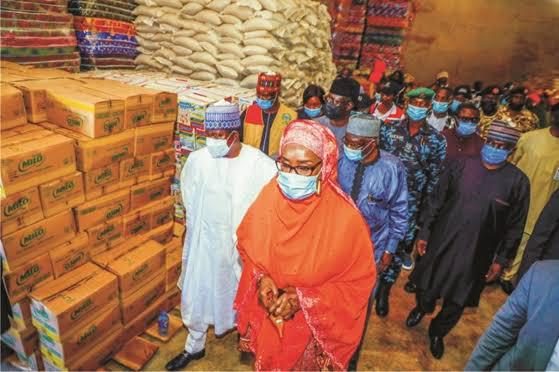
The Federal Government has announced its partnership with World Bank to conduct a post-disaster rapid impact assessment on flood victims in Nigeria.
Minister of Humanitarian Affairs, Disaster Management and Social Development, Sadiya Farouq, disclosed this at a Ministerial briefing in Abuja.
In a statement by her Special Adviser on Media, Nneka Ikem Anibeze, the minister also sent a condolence message to victims of the recent flood disaster that ravaged many states leaving on its trail hundreds of deaths.
Farouq said the post rapid impact assessment will use the Global Rapid post-disaster Damage Estimation, GRAD.
“This rapid estimation is needed because the physical Post Disaster Needs Assessment (PDNA) will take between 6 to 8 months.
“So, while we wait for the PDNA to be conducted, we can use the GRADE for planning and financial purposes.
“As GRADE has been found to be fairly accurate, the findings will guide programs of recovery and flood prevention. We are keenly waiting for the result of the GRADE assessment on or before 2nd December, 2022.
“We sympathize with the families of those who lost their lives, those who have lost their livelihoods and property. This is very unfortunate.
“We are trying our best to engage specialists and the Air Force to support us in air dropping of relief items in areas that are not accessible. We have also established 44 shelters in 24 states and most of the victims affected have been evacuated onto higher planes.
“We have taken interventions to the most hit states including Bayelsa and Jigawa, Delta Anambra and other states affected by the floods and it is still ongoing. These are natural disasters and we pray that we don’t see this again. However, the government is up and doing in this regard.
“I am currently overseeing efforts in the response phase including the activation of a national emergency operation centre and situation room that collates data, provides risk communication and coordinates the complimentary efforts of sister Ministries, Departments and Agencies (MDAs). Officials of our operational agency, the National Emergency Management Agency NEMA are in all states affected.
“We have to also seek for durable solutions towards the return and resettlement of affected communities, continue to provide lifesaving emergency assistance and prevent the spread of diseases as well as consider food insecurity challenges that may arise.
“I would like to highlight the importance of coordination and partnership in national emergencies, which is the core objective and scope of the National Flood Emergency Preparedness and Response Plan.
“The Flood Plan is currently guiding our field operations and addressing any gap in coordination we have faced at the Federal and Sub-National levels,” she said.