By Ipole AMAJAMA
In recent years, China has emerged as one of Africa’s most significant economic partners. Through massive infrastructure projects, trade agreements, and investments anchored on its Belt and Road Initiative, Beijing has positioned itself as a central player in Africa’s development narrative.
Official Chinese discourse often emphasizes “win-win cooperation,” portraying the relationship as mutually beneficial. Yet beneath this polished rhetoric lies a troubling reality: racism, exploitation, and social tensions that undermine the very foundations of partnership.
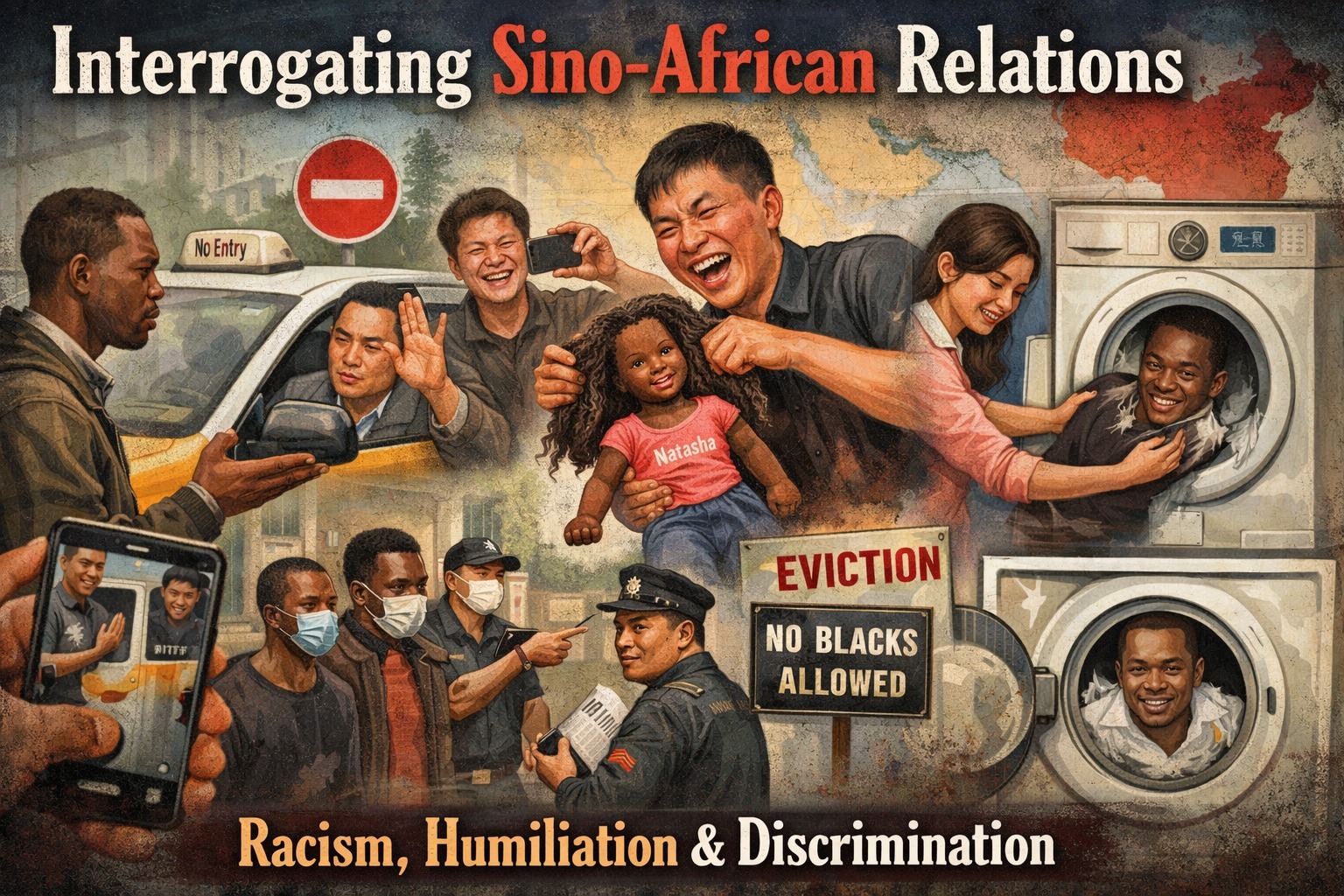
Unlike the subtle or coded forms of racism often seen elsewhere, Chinese racism toward Africans frequently manifests openly and unapologetically. The latest scandal illustrates this vividly: a Chinese taxi driver refused to take a Black passenger, an act captured on video and widely circulated on social media. The incident sparked outrage, but it was far from isolated.
Mockery and humiliation online: Videos of Chinese individuals tormenting a Black doll named “Natasha” have gone viral, trivializing racial stereotypes and reinforcing degrading caricatures.
COVID-19 discrimination: During the pandemic, African nationals in China faced eviction, forced testing, and harassment. Restaurants and hospitals refused them entry, effectively criminalizing their presence.
Racist advertising: In 2016, a Chinese detergent commercial depicted a Black man being “cleaned” in a washing machine until he emerged with lighter skin — a grotesque metaphor for racial superiority.
These examples reveal a pattern: racism is not only tolerated but normalized in Chinese society, both domestically and abroad.
China’s presence in Africa is not limited to racial discrimination. Economic exploitation and environmental destruction are equally pressing concerns.
In June 2026, authorities dismantled a counterfeit factory in Douala producing fake CFA Franc coins, operated by Chinese nationals. Such actions destabilize local economies and erode trust.
On another front, the Bendera Mining Company, a Chinese enterprise, encroached on the Kabobo wildlife reserve in the Democratic Republic of Congo, violating environmental protections and threatening biodiversity.
Data has shown that Chinese vessels account for nearly 40% of illegally caught fish off West Africa’s coast, devastating local fishing communities and undermining food security.
While the rest of the world work towards improved carbon credits, however, driven by China’s insatiable demand for rosewood, companies like Fodeco have fueled rampant deforestation. Rosewood has become the most trafficked wild product globally, surpassing ivory and rhino horn.
These practices highlight a disturbing reality: while China invests in African infrastructure, it simultaneously extracts resources illegally, leaving environmental and social devastation in its wake.
Chinese racism does not stop at China’s borders. In Africa itself, disturbing incidents reveal how discriminatory attitudes are imported and enacted against African workers.
Its interests are known for slave-like practices. In May 2026, a video from Sino Mart in Yaoundé showed a Chinese boss ordering an employee to whip another worker. The footage provoked outrage, echoing earlier incidents in 2024 where similar abuse was recorded.
It does not end there, in 2022, a video surfaced of African children being coached by a Chinese national to chant in Mandarin: “I am a Black monster and my IQ is low.” The clip went viral, exposing the exploitation of vulnerable communities.
These acts are not isolated missteps but part of a broader pattern of systemic abuse, reflecting the normalization of racist attitudes among some Chinese nationals operating in Africa.
Before you argue to the contrary, note that on Chinese social media platforms, racism toward Black people is often trivialized, poorly moderated, and even celebrated. Viral videos mocking Africans circulate freely, with little accountability.
This digital environment reinforces stereotypes and emboldens discriminatory behavior, creating a feedback loop that perpetuates racism both online and offline.
The intensification of Sino-African relations has undeniably brought economic opportunities. Roads, railways, and ports built with Chinese financing have transformed infrastructure across the continent. Yet these benefits come at a steep cost: humiliation, exploitation, and environmental destruction.
African nations now face a pressing question: must they continue to tolerate being insulted, mistreated, and robbed of their resources by Chinese nationals?
The answer lies in rethinking the terms of engagement. Partnerships must be grounded not only in economic gain but also in respect, dignity, and accountability. Without addressing racism and exploitation, the promise of “win-win cooperation” risks becoming a hollow slogan masking systemic abuse.
There is the urgency for a more equitable future for Africa and the path forward requires stronger regulation. Governments must enforce stricter laws against illegal mining, logging, and fishing, ensuring that foreign companies respect environmental and social standards.
Further, there is the demand for mechanisms in place for accountability. Incidents of racism and abuse must be met with legal consequences, not silence. While those steps are germane, African countries should be more adept at understanding geo-politics by diversification of partnerships. Reducing dependence on China by engaging with a wider range of international partners can help balance power dynamics.
While governments take these initiatives, civil society, activists have to be up and doing and this demands empowerment and capacity development to enable workers, activists, and communities to be able to amplify these abuses, challenge exploitation and demand dignity.
Sino-African relations are complex, marked by both opportunity and exploitation. While China’s investments have reshaped Africa’s economic landscape, the persistence of racism and illegal practices casts a long shadow. The challenge for African nations is to assert their sovereignty, protect their citizens, and demand respect. Only then can the promise of partnership be realized — not as a “win-win” slogan, but as a genuine foundation for mutual progress.
Amajama, a social commentator, writes from Abuja and can be reached via amajamaip@gmail.com