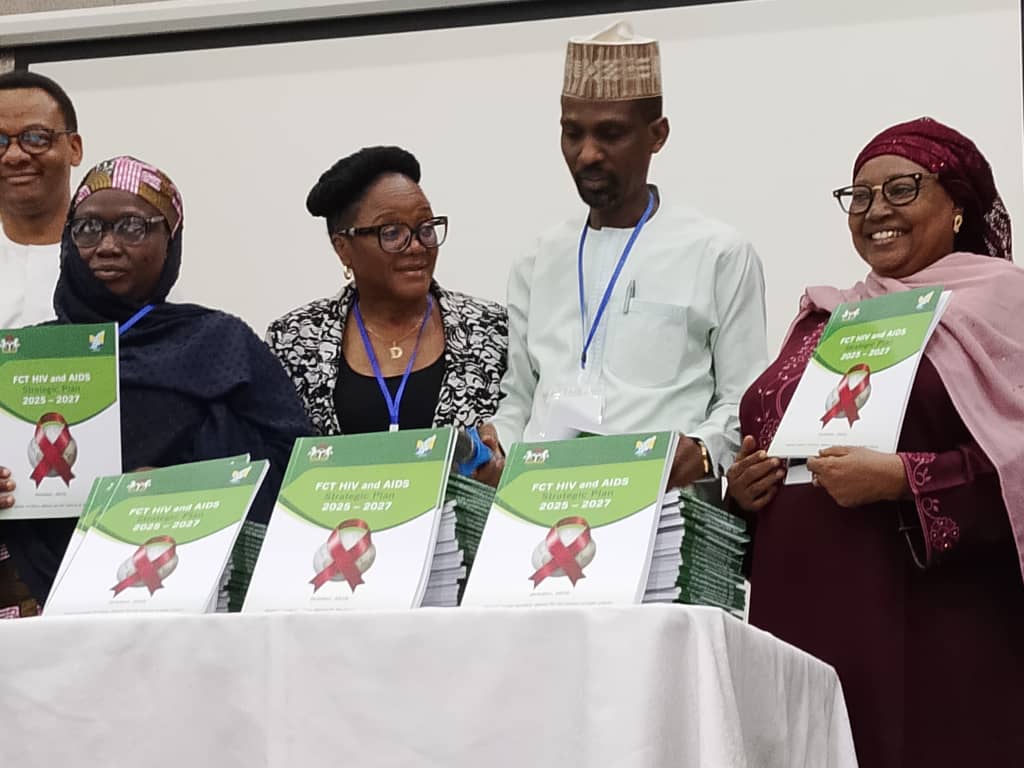
The Federal Capital Territory Administration has unveiled a N41.2 billion HIV and AIDS Strategic Plan aimed at confronting the territory’s treatment gaps and reversing its high infection burden.
Tagged the “Abuja Compact,” the 2025-2027 roadmap signals a decisive shift in the FCT’s public health posture from donor-dependent interventions to a framework built on local ownership, equity, and accountability.
The launch, which took place on Tuesday, drew stakeholders from civil society, development partners, and networks of People Living with HIV, PLHIV, underscoring the stakes as the FCT remains above national infection averages, years after the Nigeria HIV/AIDS Indicator and Impact Survey, NAIIS.
Delivering the keynote, the Mandate Secretary of the FCT Health Services and Environment Secretariat, Dr. Adedolapo Fasawe, made it clear that the urgency could no longer be masked by activity.
Fasawe, represented by Dr. Dan Gadzama, warned that despite a 100 percent Antiretroviral Therapy, ART, initiation rate among identified patients, glaring structural lapses persist.
Gender imbalance remains stark: men constitute just 32 percent of adults on treatment. Even more troubling is the situation for children 98 percent of those who require HIV care are not receiving any support, leaving only 2 percent currently covered.
Key populations, including sex workers, men who have sex with men, and people who inject drugs, account for 12 percent of new infections yet remain among the most underserved due to entrenched stigma.
Fasawe stressed that, “If we continue business as usual, the 2030 target to end AIDS will be a mirage. The FSP 2025-2027 changes the rules of engagement.”
Earlier, Project Manager of the FCT Agency for the Control of AIDS, FACA, Dr. Doris John, framed the strategy as both a collective pact and a final warning.
She described the document as “the collective will, the rigorous analysis, and the unwavering commitment of every stakeholder in this room,” stressing that the clock is ticking toward the 2030 deadline.
She appealed to the media to confront entrenched stigma head-on.
“Let us engage and deliberate on a renewed covenant to achieve an AIDS-free FCT by 2030.
A roadmap is useless without travellers, we commit to being those travellers. We commit to walking the difficult road of equity, justice, and health for all residents of the FCT-from the highbrow districts of Maitama and Asokoro to the rural communities of Abaji, and Kuje.”
The strategic plan aligns with the national “Alignment 2.0” agenda, which prioritizes homegrown solutions and community-led implementation over donor-driven programming. It is anchored on three core pillars.