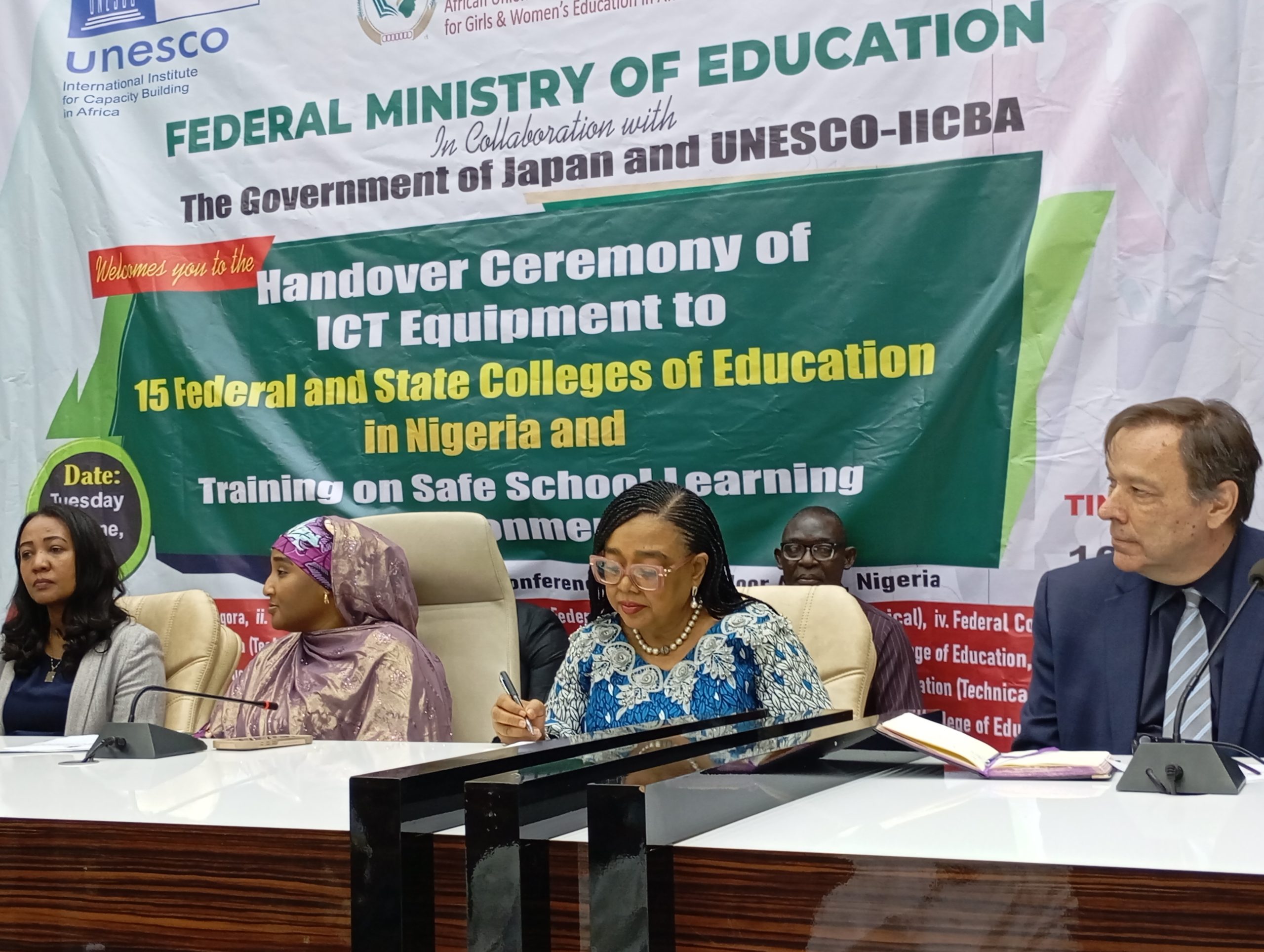
The Minister of State for Education, Prof. Suwaiba Ahmad, has urged beneficiary colleges of education to ensure judicious and sustainable use of donated Information and Communication Technology, ICT, equipment, to strengthen teacher training and enhance learning outcomes.
Ahmad made the call on Tuesday in Abuja, during the official handover of ICT equipment and materials to 15 federal and state colleges of education under a UNESCO-supported project funded by the Government of Japan.
While delivering remarks at the ceremony in Abuja, the minister said the intervention forms part of the project titled “Capacity-building of Teachers to Promote Continuous and Inclusive Access to Safe and Quality Education for Girls in West Africa.”
She noted that the project is being implemented by the UNESCO International Institute for Capacity Building in Africa, IICBA, in collaboration with the Government of Japan and the African Union.
Ahmad described the initiative as a significant contribution to Nigeria’s education sector, noting that it aligns with the Federal Ministry of Education’s priorities under the Renewed Hope Agenda, particularly in the areas of equity, quality education, digital transformation and inclusive learning.
According to the minister, the project, which covers six West and Central African countries nemely: Burkina Faso, Cameroon, Chad, Mali, Mauritania, and Nigeria.
She said the project is aimed at strengthening teacher training institutions and expanding equitable access to quality education, especially for girls.
“Teachers remain the backbone of every education system. No education reform can succeed without well-trained, motivated and digitally empowered teachers,” she said.
Ahmad noted that the ICT facilities would enhance both pre-service and in-service teacher education by improving access to digital learning resources, encouraging pedagogical innovation and supporting learner-centred teaching methods.
She said the equipment package includes 65 laptop computers, 71 tablets, four desktop computers, five interactive smart boards, 19 all-in-one desktop computers, 14 projectors, 15 printers and 15 backup hard drives.
The minister explained that the resources would significantly improve teaching and learning experiences in the beneficiary institutions while helping to produce digitally competent teachers capable of meeting the demands of a rapidly evolving educational landscape.
She also highlighted the importance of the accompanying training programme on safe school learning environments and infrastructure security, describing school safety as critical to achieving quality and inclusive education, particularly for girls and vulnerable learners.
Ahmad reiterated that the Federal Ministry of Education remains committed to advancing teacher quality, digital literacy, inclusive education and institutional capacity-building through strategic partnerships with development partners and international organisations.
She further disclosed that the ministry is pursuing additional interventions, including projects focused on empowering female teachers and school leaders in crisis situations through mobile-based learning and integrating out-of-school children into formal education.
While congratulating the beneficiary institutions, the minister urged them to maximise the opportunities provided by the intervention and the accompanying capacity-building programmes on ICT-driven inclusive teaching, gender-responsive education, school safety policies and infrastructure security.
Ahmad expressed appreciation to UNESCO-IICBA, the Government of Japan, the African Union and other partners for their support in strengthening teacher education in Nigeria and across West Africa.
The 15 beneficiary institutions were drawn from the six geo-political zones of the country and include both federal and state-owned Colleges of Education.
Also speaking, the Charge d’Affaires of the Japanese Embassy in Abuja, Mr. Hitoshi Kozaki, reaffirmed Japan’s commitment to supporting quality, inclusive and technology-driven education in Nigeria through sustained investments in teacher development and digital learning.
Speaking on the distribution of ICT equipment, Kozaki said the intervention reflects Japan’s longstanding commitment to improving education systems across Africa, particularly for girls and vulnerable children.
He noted that many countries in Sub-Saharan Africa continue to face challenges such as inadequate funding, shortages of qualified teachers and unequal access to quality education, adding that these obstacles are often more severe for girls due to poverty, gender-based violence and restrictive cultural practices.
According to him, well-trained and motivated teachers remain central to building resilient education systems capable of delivering inclusive and quality learning outcomes.
Kozaki said the project promotes digital learning, inclusive teaching practices and continuous professional development, stressing that digital competencies have become essential in modern education.
He emphasized that the true value of the ICT equipment would be measured by how effectively it is utilized to improve teacher preparation, enrich classroom instruction and expand learning opportunities for children, especially girls.
The envoy pledged Japan’s continued collaboration with Nigeria, UNESCO and other partners to advance safe, inclusive and digitally empowered education for all.
On his part, the Director of UNESCO IICBA, Dr. Quentin Wodon, praised Nigeria’s contributions to advancing teacher development and inclusive education, describing some of the country’s home-grown initiatives as models with global relevance.
Wodon said experiences from the field continue to provide valuable lessons on improving educational outcomes across Africa and beyond.
He highlighted the work of the Centre for Diversity and Inclusion, a Nigerian organization, noting that its innovative approaches to education and social inclusion have attracted international recognition.
According to him, the organisation recently published findings in Nature, one of the world’s leading academic journals, demonstrating the positive impact of its programmes on participants and reinforcing the value of locally driven solutions to educational challenges.
The IICBA Director said the institute looks forward to drawing lessons from successful initiatives in Nigeria as part of broader efforts to strengthen teacher education and learning systems across the continent.
He expressed appreciation to the Federal Government and its partners for their longstanding collaboration with IICBA, noting that the ICT intervention would help improve teacher preparation and institutional capacity.
He expressed optimism that the project would make a meaningful difference in the lives of teachers and learners while advancing quality education in Africa.