By Ijeoma UKAZU
Cervical cancer, is the fourth most common cancer in women globally, with an estimated 604, 000 new cases and 342,000 deaths in 2020. About 99 per cent of the new cases and deaths worldwide in 2020 occurred in low-and middle-income countries, according to the World Health Organisation, WHO.
Research by The Lancet, a global health and science journal reveals that more than 44 million women globally, stand to develop cervical cancer between 2020 and 2069.
The study also warned that deaths from cervical cancer will increase a further 50 per cent by 2040 and that many women, their families and communities will be impacted.
Although the causes of cancer are unknown, 14 out of the 100 types of Human Papillomavirus, HPV, strains have been identified to cause at least 99 per cent of cervical cancer cases.
In Nigeria, the Lagos state government is putting up measures to curb cervical cancer deaths by early screening and detection with no fewer than 53,000 women screened for cervical cancer.
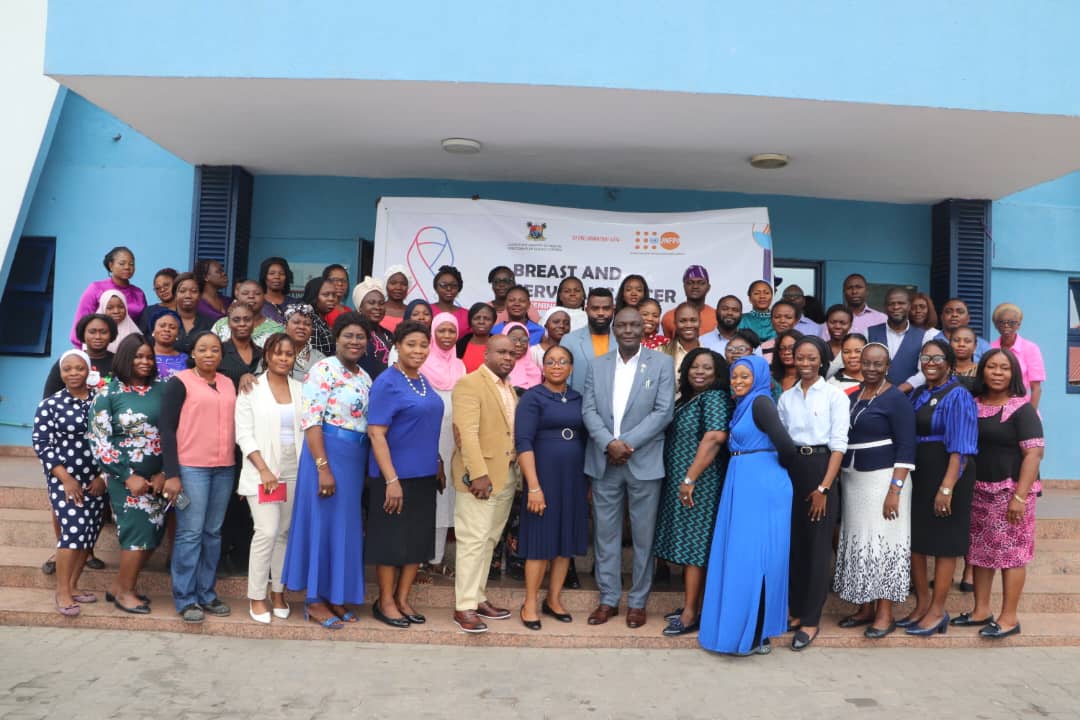
The state also trained 200 health workers drawn from 60 public health facilities including the State University Teaching Hospital, LASUTH, 15 General Hospitals and 44 Primary Health Care Centres have been trained to provide breast and cervical cancer screening for citizens in their facilities.
The eight-day training program sponsored by the Lagos state government in collaboration with the United Nations Population Fund, UNFPA, is targeted to increase access to cancer screening services in all state health facilities.
Speaking at the close of the capacity-building workshop, the permanent secretary, Ministry of Health, Dr Olusegun Ogboye noted that the partnership between the state government and UNFPA on the cancer control program is geared toward making cancer screening services more accessible and readily available in public health facilities in Lagos.
Ogboye, who was represented by the Director of Disease Control in the Lagos State Ministry of Health, Dr Rotimi Agbolagorite, explained that the capacity-building workshop is part of a larger partnership support arrangement leveraging available resources to improve access to cancer screening services.
In his words: “The ministry’s efforts to make cancer screening services more accessible and readily available in all state health facilities, has been further strengthened with the recent support from one of our development partners, UNFPA.
“Apart from the capacity-building workshop for the 200 state health workers, the Ministry is being supported by UNFPA with the donation of 15,000 units of disposable speculums, 180 pieces of couch rolls and 260 pieces of K-Y jelly which are requisite consumables for the provision of effective breast and cervical cancer screening and management services.”
He added that UNFPA is also supporting the state government to improve community sensitization and public enlightenment on the availability of free breast and cervical cancer screening services in 60 designated public health facilities across the state.
The permanent secretary disclosed that the state government has so far screened a total of 53,762 women since the inception of the free breast and cervical cancer screening in the 60 designated health facilities
“A total of 53,762 women have been screened since inception, out of which a total of 2,635 representing 4.9 per cent of women screened were screened positive for cervical precancerous lesions and 2,348 (89 per cent) of these positively screened women were treated with thermal ablation and saved from possibly developing cervical cancer in the future. Furthermore, a total of 99 women representing 0.2 percent of the total women screened were referred with suspicious lesions and possible early stages of cancer, for prompt diagnosis and early treatment which would result in an improved management outcome”, he said.
Earlier, the Head of Office, Lagos Liason Office, UNFPA, Dr Omolaso Omosehin, who was represented by Maternal and Family Planning Analyst, UNFPA, Dr Akinkunmi Akinbajo, commended Lagos state for improving access to cervical and breast cancer screening services noting that the has continued to blaze the trail in providing access to maternal and child health services.
He said: “At the UNFPA, we are very glad to support the Lagos state government in this training of 200 health workers across 60 health facilities, and we are glad to improve access to cancer screening generally. As we all know the leading causes of cancer mortality in women are the breast and cervix, and if we can tackle this, then we are sure that our women will live longer and be able to protect and provide for their families.
“By so doing, we will also have affected a lot of other targets of the SDGs. This particular training is linked to SDG 3.7; ensuring universal access to sexual and reproductive health, and again it is contributing to goal 3.4 which is preventing and ending all forms of mortality from non-communicable diseases. So, we are glad to be supporting Lagos”
Omosehin pledged the support of UNFPA to deepen its partnership with Lagos beyond the present 60 free cancer screening sites adding that the UNFPA will do more to improve access to breast and cervical cancer screening services.
He also red the commitment of UNFPA to achieving three zeros by 2030, explaining that the aim is to achieve zero preventable maternal deaths which are why the UNFPA is supporting the cancer control program.
“The second zero is to end all unmet needs of family planning and the third zero is to eradicate all forms of gender-based violence against women which include female genital mutilation, early child marriage and harmful traditional practices”, he noted.
In her remarks, the Lagos State Focal person, Cancer Control Program, Dr Abosede Wellington, explained that the best way to prevent breast and cervical cancer is through early and regular screening noting that early detection of breast and cervical cancer will lead to better manage which will go a long way in saving lives.
She urged women to visit any of the 60 cancer screening sites located across the state to avail themselves of the opportunity of the free breast and cervical cancer screening exercise being provided by the state government.
“Breast and cervical cancers are cancers that are very common in our environment and the best way we can catch them early and save the lives of our mothers, sisters and daughters who die from cancer is through screening and early detection. The best way to prevent cancer is through early and regular screening. In Lagos state, we provide free breast and cervical screening services and these services are available in 60 health facilities across the 20 LGA in the state,” she said.
A participant, Evelyn Olufunke applauded the state government for organizing the highly impactful capacity-building workshop noting her resolve to enlighten clients on the need to submit for breast and cervical screening has been boosted by the training program
“The responsibility falls on us health workers to go back to the community to educate and mobilize citizens to go for screening.
She explained further that the training has also improved her knowledge of breast and cervical cancer screening adding that the take-home from the training is a commitment to cascade the knowledge shared at the workshop to other health workers.