By Sarah NEGEDU
Thousands of residents of Bwari, Ushafa and neighbouring communities are set to benefit from safe, treated water as the Federal Government moves to end years of dependence on untreated boreholes and streams across satellite towns in the Federal Capital Territory.
President Bola Tinubu, on Tuesday, said the Bwari Township Water Supply Network was part of plans to expand potable water infrastructure beyond Abuja city, pledging that similar projects would reach Kuje, Kwali, Gwagwalada and Abaji before the end of his tenure.
The President said the initiative demonstrates his administration’s resolve to bridge the infrastructure gap between the city centre and satellite communities, insisting that access to clean water is a fundamental right and not a luxury.
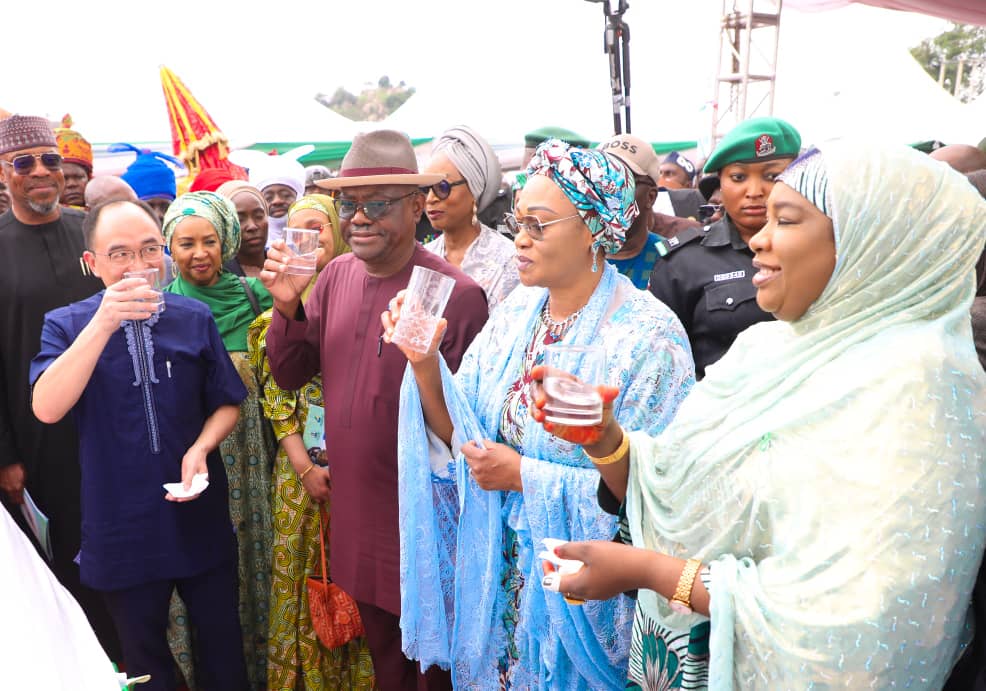
Tinubu, who was represented by the First Lady, Senator Oluremi Tinubu, at the commissioning of the project in Bwari, said the Renewed Hope Agenda was deliberately designed to decentralise development and improve the quality of life of residents in underserved communities.
“The Renewed Hope Agenda is not a slogan. It is a contract. It is a deliberate, calculated, and unyielding commitment to governance that works for the people.
“For too long, the narrative of Abuja has been a tale of two cities-a glittering center surrounded by underserved communities. We said no.
“That era is gone. Nigeria belongs to all of us, and development must be decentralized!”
The 198-kilometre water pipeline network, constructed by China Geo-engineering Construction, CGC, Limited, links Bwari Township, Ushafa and surrounding communities directly to the Lower Usuma Dam, providing residents with access to treated water.
Tinubu said he approved the project after learning that residents had depended on untreated water sources for years.
“When the Honorable Minister of the FCT, Barrister Nyesom Wike, came to me with the master plan for these interventions, I looked at the files. I saw that for years, our people in Bwari, Ushafa, and surrounding communities have relied on untreated boreholes and streams.
“Water is life. Clean water is dignity. It is a fundamental right, not a luxury. I gave him a direct order: ‘Go out there, mobilize the best, and fix it’.”
He said the project would improve public health by reducing waterborne diseases while ending the costly practice of digging private boreholes.
“This project is much more than just laying pipes and turning on taps. By linking Bwari Township and its environs directly to our major treated water source at the Lower Usuma Dam, we are ending waterborne diseases and the constant, expensive digging of individual boreholes.”
Tinubu said more than 1,600 direct and indirect jobs were created during the execution of the project and reaffirmed his administration’s commitment to extending the water programme to other satellite towns.
“Last year, it was the Lower Usuma Dam Phase 2 rehabilitation; last month, it was the Karu water network; today it is Bwari.
“And I assure you, by the grace of Almighty God, before our tenure is through, this water revolution will fully cover Kuje, Kwali, Gwagwalada, and Abaji.”
Earlier, the FCT Minister, Nyesom Wike, said the Bwari project fulfilled Tinubu’s directive that potable water should no longer be limited to Abuja city.
He said the administration had deliberately expanded investment beyond road construction to ensure residents also benefited from improved water infrastructure.
“Since Mr. President came into office in 2023, he has provided water for the city centre, water for Karu and neighbouring communities, and today, water for Bwari.
“Let people know that we are not concentrating on roads; we are also making sure other sectors are being touched. That is why we are here.”
Wike disclosed that the administration had officially commissioned 50 major projects since Tinubu assumed office in May 2023 and would inaugurate another 10 before election campaigns begin next year.
On her part, the Minister of State for the FCT, Dr. Mariya Mahmoud, described the project as another milestone in expanding access to safe drinking water.
She added that the project fulfilled the administration’s promise to expand access to critical infrastructure and improve the quality of life of residents in satellite communities.
Mahmoud added that access to clean water would improve public health, enhance livelihoods and restore public confidence in government, while reaffirming the FCT Administration’s commitment to delivering more people-centred infrastructure projects.